chess piece moves chart pdf
Summary
Need a handy chess moves chart in PDF format? Download our easy-to-understand guide & level up your chess game! Perfect for beginners to pros. Get the PDF now!

Chess Piece Moves Chart PDF: A Comprehensive Guide
Discover a detailed PDF resource outlining each piece’s movement, including forcing moves, openings like d4/e4, and endgame strategies for improved calculation!
Chess piece movement forms the bedrock of strategic gameplay, demanding a clear understanding for both beginners and seasoned players. A comprehensive chess piece moves chart PDF serves as an invaluable tool, detailing the unique capabilities of each piece – from the pawn’s initial two-square advance to the queen’s combined rook and bishop-like mobility.
Mastering these movements, including the knight’s unusual ‘L-shape’ and the king’s limited one-square range, is crucial. Recognizing forcing moves – checks, captures, and threats – unlocks tactical combinations and enhances calculation skills, as highlighted in resources focusing on stock forcing moves exercises.
Understanding the Importance of a Chess Moves Chart
A chess moves chart PDF isn’t merely a reference; it’s a pathway to improved pattern recognition, a cornerstone of chess mastery. Quickly grasping essential movements allows players to focus on strategy rather than calculation. These charts distill complex rules into a readily accessible format, aiding beginners in learning openings like d4 and e4.
Furthermore, charts facilitate understanding of forcing moves, vital for tactical combinations and endgame play. Resources like those detailing stock forcing moves exercises emphasize this benefit, accelerating skill development and intuitive gameplay.
The Pawn: Basic Movement and Capture
Pawns, often underestimated, possess unique movement rules detailed in chess moves chart PDFs. Initially, a pawn can advance one or two squares, a crucial element in opening strategies. Subsequently, it moves only one square forward. Capture, however, occurs diagonally, adding a tactical layer.
Understanding these nuances, including en passant, is fundamental. Charts visually represent these rules, aiding beginners in mastering pawn structure and its impact on both offense and defense, as highlighted in beginner cheat sheets.
Initial Pawn Moves (One or Two Squares)
Chess moves chart PDFs clearly illustrate a pawn’s initial flexibility. From its starting rank, a pawn has the option to advance either one or two squares forward. This choice impacts opening development and control of the center.
Beginner resources emphasize this unique rule, as it’s a one-time opportunity. Selecting the two-square advance can quickly open lines for other pieces, but also potentially weaken pawn structure, a key consideration detailed in instructional materials.

Pawn Capture Mechanics (Diagonally)
Chess piece moves PDF guides highlight a crucial pawn rule: pawns capture differently than they move. While advancing is straight forward, capturing occurs diagonally forward one square. This distinction is vital for beginners, often a source of confusion.
Charts visually demonstrate this, showing capture squares. Understanding diagonal capture is fundamental for tactical calculations and avoiding material loss. Resources emphasize practicing pawn captures to solidify this core mechanic, improving overall game awareness.
The Rook: Straightforward Movement
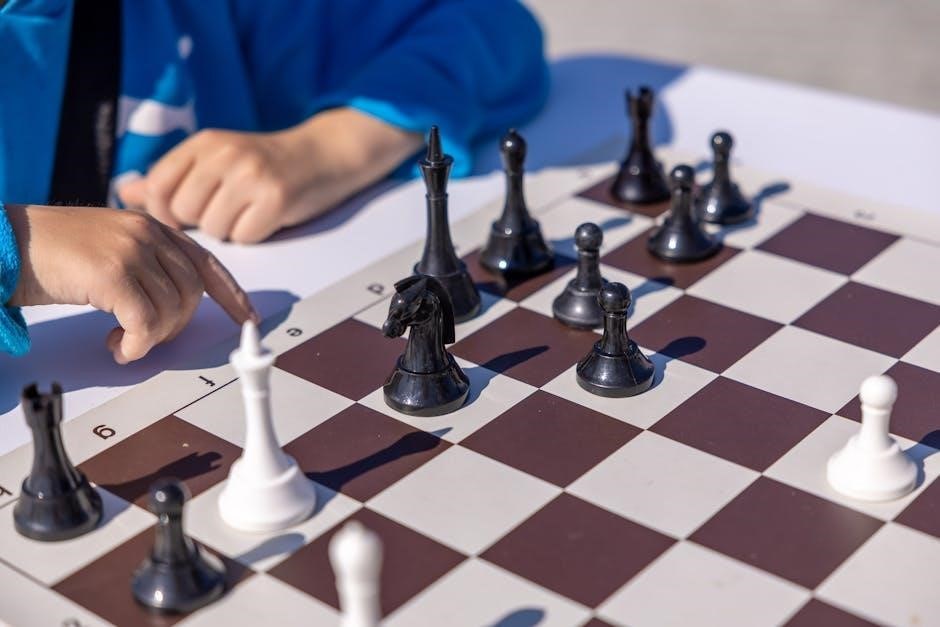
Chess piece moves PDF charts clearly illustrate the rook’s linear movement. Rooks travel any number of unoccupied squares horizontally or vertically – along ranks and files. This simplicity makes them powerful in open positions.
Guides emphasize the rook’s role in castling, a special move enhancing king safety. Mastering rook movement is essential for controlling open files and coordinating attacks. Visual aids within the PDF demonstrate effective rook placement and strategic utilization.
Rook Movement Along Ranks and Files
Chess PDF guides detail how rooks move unimpeded along ranks (horizontal rows) and files (vertical columns). They can traverse the board freely, provided no pieces obstruct their path. Understanding this is fundamental to controlling key areas.
Charts often highlight the rook’s strength on open files, maximizing its influence. PDF resources demonstrate how to utilize rooks for both offensive and defensive purposes, emphasizing their long-range capabilities and strategic importance in various game phases.
Rook’s Role in Castling
Chess PDF charts clearly illustrate the rook’s vital role in castling, a special move enhancing king safety. Castling involves the king moving two squares towards a rook, with the rook then jumping over the king to the adjacent square.
PDF guides emphasize castling’s benefits – improved king protection and rook activation. They detail the conditions required for castling, such as no pieces between the king and rook, and the king not being in check or passing through check.
The Knight: The Unique “L-Shape” Move
Chess PDF resources highlight the knight’s distinctive movement – an “L” shape: two squares in one direction (horizontal or vertical), then one square perpendicularly. PDF charts visually demonstrate this pattern, crucial for beginners.
PDF guides emphasize the knight’s unique ability to jump over other pieces, unlike rooks or bishops. This makes it invaluable for navigating crowded boards and launching unexpected attacks. Mastering the knight’s move is key to tactical success.
Visualizing the Knight’s Movement Pattern
Chess PDF charts often employ grid-based diagrams to illustrate the knight’s reach. These visuals demonstrate all possible “L” shaped moves from any given square, aiding pattern recognition. PDF resources showcase how the knight controls squares of the opposite color to its starting square.
Beginner PDF guides suggest practicing knight movement exercises, tracing paths on a chessboard. This builds spatial awareness and helps internalize the unique pattern, crucial for calculating combinations and anticipating opponent’s moves effectively.
Knight’s Ability to Jump Over Pieces
Chess PDF guides emphasize the knight’s unique ability to leap over intervening pieces – a defining characteristic. Diagrams within these PDFs clearly illustrate this, showing the knight bypassing obstructions to reach its destination square. This contrasts sharply with other pieces.
PDF resources highlight how this jumping ability makes the knight effective in crowded positions, exploiting vulnerabilities others can’t reach. Mastering this concept, visualized in charts, is key to tactical success and strategic planning.
The Bishop: Diagonal Movement
Chess PDF charts detail the bishop’s movement exclusively along diagonals, emphasizing its confinement to either light or dark squares. These guides visually demonstrate how a bishop’s color dictates its reach across the board, impacting strategic positioning.
PDF resources often highlight the power of a “bishop pair,” controlling both color complexes. Understanding this, as shown in diagrams, is crucial for developing effective attacks and defensive structures, improving overall game play.

Bishop Movement on Colored Squares
Chess PDF charts clearly illustrate a fundamental rule: each bishop remains bound to the color square it starts on throughout the game. This limitation dictates the squares it can control and influence, impacting strategic planning.
Detailed diagrams within these PDF guides showcase how bishops can dominate one color complex while being entirely ineffective on the other. Mastering this concept is vital for understanding positional advantages and formulating effective attack plans.
The Importance of Bishop Pairings
Chess PDF resources emphasize the significant advantage gained by possessing both bishops – a “bishop pair.” This dynamic duo controls both color complexes, offering greater flexibility and attacking potential compared to a bishop and knight combination.
Charts demonstrate how the bishop pair excels in open positions, coordinating attacks and restricting opponent’s piece movement. PDF guides often highlight strategic scenarios where leveraging the bishop pair leads to decisive advantages, particularly in the endgame.
The Queen: The Most Powerful Piece

Chess PDF charts detail the Queen’s unparalleled power, combining the movements of both the Rook and Bishop. This allows for control across ranks, files, and diagonals, making her a formidable attacking and defensive force.
Guides illustrate strategic Queen placements, emphasizing her role in controlling key squares and launching decisive attacks. PDF resources often showcase tactical combinations utilizing the Queen’s versatility, highlighting her importance in both opening and endgame scenarios.
Queen’s Combined Movement (Rook & Bishop)
Chess PDF charts visually demonstrate the Queen’s unique ability to move any number of squares horizontally, vertically, or diagonally. This combines the linear movement of the Rook with the diagonal reach of the Bishop;
Diagrams within these resources clearly illustrate how the Queen dominates the board, controlling multiple lines of attack simultaneously. Understanding this combined movement is crucial for effective strategic planning and tactical calculations, as highlighted in many PDF guides;
Strategic Uses of the Queen
Chess PDF resources emphasize the Queen’s power in both attack and defense. Strategic deployment involves controlling open files and diagonals, supporting pawn advances, and delivering decisive checks.
PDF charts often showcase examples of Queen sacrifices for tactical advantage, or utilizing her long-range capabilities to pressure weak squares. Mastering the Queen’s strategic uses, as detailed in these guides, is vital for converting positional advantages into winning combinations.
The King: Limited but Crucial Movement
Chess PDF guides highlight the King’s one-square movement in any direction, emphasizing its vulnerability and importance. Understanding “check” and prioritizing King safety are fundamental concepts detailed within these resources.
PDF charts illustrate how King activity increases dramatically during the endgame, becoming a powerful attacking piece. Protecting the King from attack, and knowing when to activate it, are crucial skills taught in comprehensive chess movement guides.
King’s One-Square Movement
Chess PDF resources clearly demonstrate the King’s restricted movement – only one square in any direction, horizontally, vertically, or diagonally. Detailed diagrams visually represent this limitation, crucial for beginners.
These charts emphasize that while limited, this movement is vital for avoiding “check” and coordinating with other pieces. PDF guides often include exercises focusing on safe King positioning and recognizing immediate threats, reinforcing this fundamental rule.
The Concept of “Check” and King Safety

Chess PDF charts meticulously explain “check,” where the King is under immediate attack. Visual aids demonstrate how to resolve a check – moving the King, blocking the attack, or capturing the attacking piece;
Comprehensive guides prioritize King safety, emphasizing the importance of castling and surrounding the King with pawns and pieces. PDF resources often include tactical exercises focused on identifying checkmate threats and developing defensive strategies, vital for all skill levels.
Special Moves: Castling and En Passant
Chess PDF charts detail castling, a move involving the King and a Rook, enhancing King safety and developing the Rook simultaneously. Clear diagrams illustrate the specific conditions required for legal castling, avoiding pitfalls.

Furthermore, these guides explain en passant, a unique pawn capture. PDF resources visually demonstrate the timing and execution of this special move, often overlooked by beginners, adding depth to understanding chess tactics.
Castling Rules and Benefits
Chess PDF guides meticulously outline castling rules: King and Rook haven’t moved, no pieces between them, King isn’t in check, doesn’t pass through check, and doesn’t end in check.
Benefits include improved King safety, moving the King towards the corner, and activating the Rook. Detailed diagrams within the PDF illustrate legal and illegal castling scenarios, ensuring players grasp this crucial defensive maneuver effectively.
En Passant: A Unique Pawn Capture
Chess PDF charts explain en passant: if a pawn advances two squares from its starting rank, landing beside an opponent’s pawn, that opponent’s pawn can capture it “as if” it moved only one square.
Crucially, this capture must be made immediately on the next turn. PDF diagrams clearly demonstrate the conditions for a legal en passant capture, enhancing understanding of this often-misunderstood rule within the game.
Chess Openings and Beginner Strategies (Referencing Common Openings like d4/e4)
Chess PDF guides often include sections on openings, highlighting common first moves like d4 and e4. These charts illustrate initial pawn structures and typical development plans for each opening.
Beginner strategies detailed in PDFs emphasize controlling the center, developing pieces quickly, and king safety. Understanding these foundational principles, alongside opening move sequences, accelerates learning.
Forcing Moves and Tactical Combinations

Chess PDF resources dedicated to tactical training emphasize recognizing forcing moves – checks, captures, and threats – as keys to calculation. These charts often present exercises focused on combinations utilizing such moves.
PDF guides detail how to exploit forcing sequences, including zwischenzugs (intermediate moves) and defensive tactics. Mastering these concepts, alongside pattern recognition, dramatically improves a player’s combinational vision.
Recognizing Forcing Moves (Checks, Captures, Threats)
Chess PDF guides highlight that forcing moves – checks, captures, and direct threats – demand immediate responses from your opponent, limiting their options.
Charts often categorize exercises by these move types, building recognition skills. PDF resources emphasize calculating the consequences of each forcing move, evaluating resulting positions, and identifying potential combinations arising from these tactical opportunities.
Utilizing Forcing Moves in Combinations
Chess PDF materials demonstrate how chaining forcing moves – a sequence of checks, captures, or threats – creates powerful combinations. Charts illustrate building upon initial forcing moves, exploiting weaknesses revealed by opponent’s responses.
PDF exercises focus on recognizing patterns where forcing moves lead to material gain, improved position, or even checkmate. Mastering this skill, as shown in PDF guides, is crucial for tactical prowess.
Endgame Considerations and Piece Movement
Chess PDF resources emphasize king activity in endgames, showcasing how centralizing the king supports pawn advances and restricts opponent’s pieces. Charts detail pawn promotion strategies, highlighting the importance of creating passed pawns.
PDF guides illustrate how simplified positions demand precise piece coordination. Mastering endgame forcing moves, as presented in PDF exercises, becomes paramount for converting advantages into victory, often involving careful pawn structure analysis.

King Activity in the Endgame
Chess piece moves charts, particularly in PDF format, stress the king’s transformation from a vulnerable target to an active fighting piece during endgames. PDF guides demonstrate how centralizing the king supports pawn advances and restricts opponent mobility.
Resources highlight the king’s role in opposition, creating zugzwang, and assisting in pawn promotion. Mastering king activity, as shown in PDF exercises, is crucial for converting even slight advantages into a winning position.
Pawn Promotion and Endgame Strategy
Chess piece moves charts in PDF format emphasize pawn promotion as a decisive endgame tactic. PDF guides illustrate calculating promotion squares, considering underpromotion options, and leveraging passed pawns to create threats.
Resources detail how pawn structure dictates endgame strategy, with PDF exercises focusing on king and pawn endgames; Understanding promotion’s impact, as shown in PDF examples, is vital for maximizing winning chances and achieving a favorable outcome.
Resources for Chess Piece Moves Charts (PDF Format)
Numerous online platforms offer downloadable chess piece moves charts in PDF format. ChessKid.com provides beginner-friendly cheat sheets, while Chess-Game-Strategies.com offers comprehensive guides. DOKUMEN.PUB hosts detailed resources, including exercise books focusing on forcing moves and tactical combinations.
Reddit’s r/chess community shares curated catalogs of openings and learning materials, often available as PDFs. These resources aid pattern recognition and improve calculation skills, enhancing overall chess understanding.
Pattern Recognition and Chess Improvement
Mastering chess hinges on recognizing recurring patterns, a skill significantly boosted by studying chess piece moves charts. These charts accelerate the grasp of essential tactical motifs and strategic setups. Resources like those found on DOKUMEN.PUB emphasize exercises designed to hone this ability.
Improved pattern recognition leads to quicker, more accurate calculations, enabling players to anticipate opponent’s moves and formulate effective responses, ultimately elevating their game.

Intuition and Creativity in Chess Movement
While chess piece moves charts provide a foundational understanding, true mastery requires developing intuition and creativity. PDF resources, like those detailing forcing moves, build a base for recognizing unexpected opportunities.
Exercises focusing on Zwischenzugs and defensive tactics, as highlighted on DOKUMEN.PUB, encourage players to move beyond rote memorization and explore unconventional, yet effective, approaches to the game.